Skip to contents

1 Introduction

The vectormetrics package calculates landscape metrics based on vector polygon representations. It shares many metrics with the landscapemetrics package which offers landscape metrics for raster data. In principle, both packages should produce similar or nearly identical results as long as the input data is equivalent (e.g., raster and vector representations of the exact polygon geometry). However, differences can arise due to several factors, including computational approaches, treatment of polygon boundaries, and underlying assumptions about how landscape features are measured.

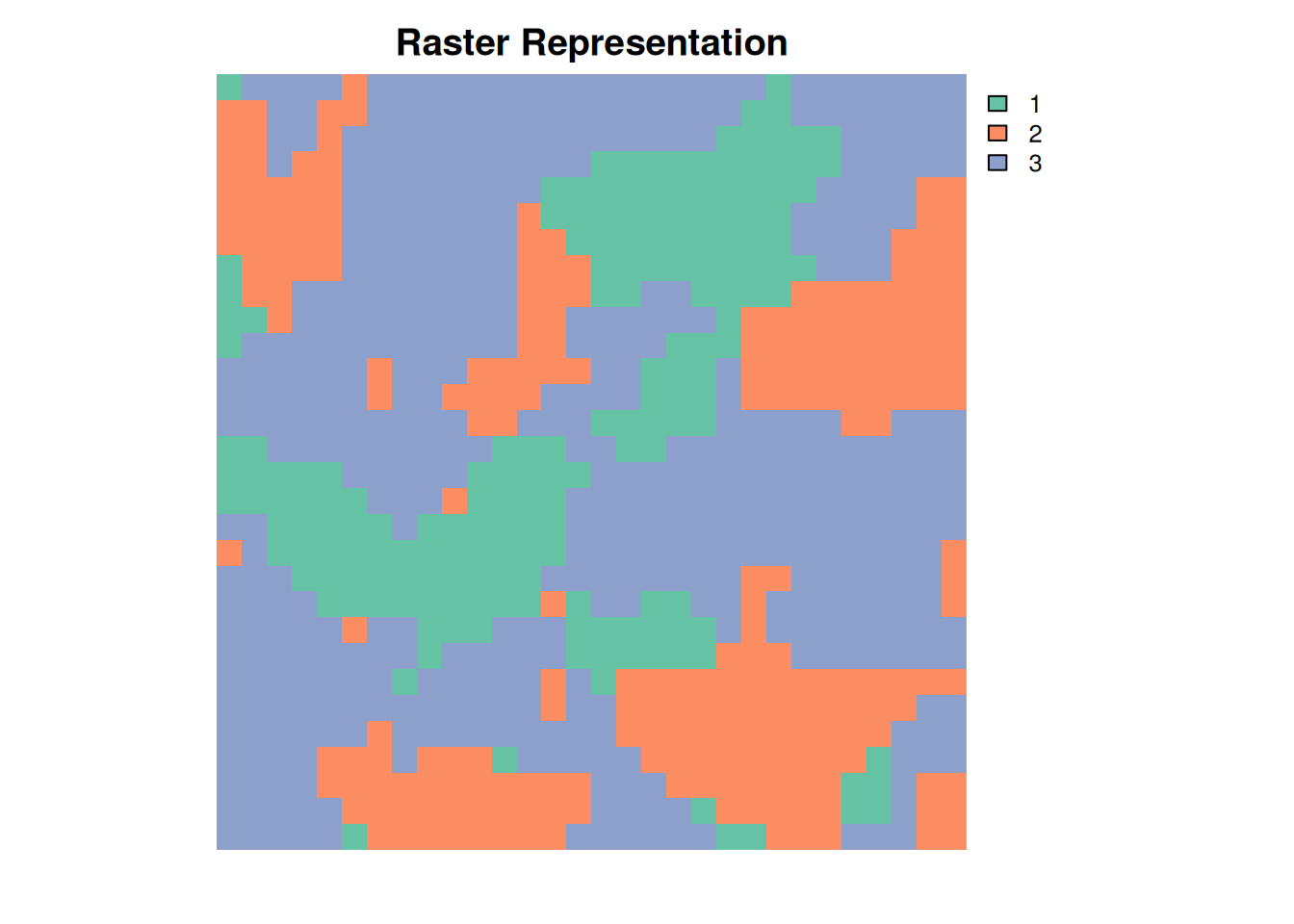
This comparison uses the landscapemetrics::landscape dataset, a 30×30 cell raster at 1m resolution containing 3 classes across 28 patches (9 patches in class 1, 13 in class 2, and 6 in class 3). The same landscape was converted to vector polygons for comparison.

Note: When converting polygon data to raster for analysis with landscapemetrics, the rasterization process affects the actual landscape structure. Coarser resolutions can eliminate small patches entirely, merge adjacent patches, and distort patch boundaries – fundamentally changing what is measured. These structural changes cascade through all dependent metrics: patch counts change, patch areas and shapes shift, which then affects perimeter-based metrics (te, ed, shape, circle, lsi), distance calculations (enn, proximity), and core area detection (cai, dcore). This vignette uses an idealized scenario in which we have exactly the same landscape in both formats to show the pure representation difference – but in practice, converting your polygons to raster will change the landscape structure and thus the metrics you get.

2 Summary of comparison

This comparison evaluates 78 metrics that exist in both packages, organized across three analysis levels:

  • Patch level: 9 metrics
  • Class level: 39 metrics
  • Landscape level: 30 metrics

Beyond these shared metrics, vectormetrics offers 61 exclusive metrics not found in landscapemetrics – primarily specialized shape complexity and geometry measures suited to vector polygon analysis.

3 Metrics with perfect or near-perfect agreement

Many metrics show perfect or near-perfect agreement, with absolute differences less than 0.001 on our test landscape. These metrics are robust to the vector-raster representation difference because they rely on count-based, proportion-based, or compositional calculations that behave consistently across representations. When patches agree at the patch level, those agreements propagate to class and landscape levels since higher levels aggregate patch-level data.

3.1 Patch level: metrics with close agreement

Code
patch_close <- patch_metrics |>
  filter(abs_diff < 0.001, class == 1) |>
  group_by(metric_name) |>
  ungroup() |>
  select(metric_name, class, n_patches_vm, n_patches_lsm, value_vm, value_lsm, abs_diff, vm_units) |>
  arrange(metric_name)

kable(
  patch_close,
  digits = 3,
  caption = sprintf("Patch-level metrics with close agreement: %d unique metrics", 
                    n_distinct(patch_close$metric_name)),
  col.names = c("Metric", "Class", "N Patches VM", "N Patches LSM", "VM Value", "LSM Value", "Abs Diff", "Units")
)
Patch-level metrics with close agreement: 4 unique metrics
Metric Class N Patches VM N Patches LSM VM Value LSM Value Abs Diff Units
p_area 1 9 9 0.002 0.002 0 hectares
p_core 1 9 9 0.001 0.001 0 hectares
p_frac 1 9 9 1.218 1.218 0 index (dimensionless)
p_perim 1 9 9 21.556 21.556 0 meters

4 patch-level metrics show close agreement across all patches within class 1. These foundational patch-level agreements are carried forward to higher aggregation levels. Note that p_core are idential because we use the same core distance threshold – but in practice, differences in core area detection methods (buffer vs. erosion) can lead to differences in core area metrics.

3.2 Class level: metrics with close agreement

Code
class_close <- class_metrics |>
  filter(abs_diff < 0.001, class == 1) |>
  group_by(metric_name) |>
  ungroup() |>
  select(metric_name, class, value_vm, value_lsm, abs_diff, vm_units) |>
  arrange(metric_name)

kable(
  class_close,
  digits = 3,
  caption = sprintf("Class-level metrics with close agreement: %d unique metrics (class 1 shown)", 
                    n_distinct(class_close$metric_name)),
  col.names = c("Metric", "Class", "VM Value", "LSM Value", "Abs Diff", "Units")
)
Class-level metrics with close agreement: 17 unique metrics (class 1 shown)
Metric Class VM Value LSM Value Abs Diff Units
c_area_cv 1 156.026 156.026 0 percent (%)
c_area_mn 1 0.002 0.002 0 hectares
c_area_sd 1 0.003 0.003 0 hectares
c_ca 1 0.018 0.018 0 hectares
c_core_mn 1 0.001 0.001 0 hectares
c_core_sd 1 0.001 0.002 0 hectares
c_division 1 0.985 0.985 0 index (dimensionless)
c_frac_cv 1 17.924 17.924 0 percent (%)
c_frac_mn 1 1.218 1.218 0 index (dimensionless)
c_frac_sd 1 0.218 0.218 0 index (dimensionless)
c_lpi 1 8.889 8.889 0 percent (%)
c_mesh 1 0.001 0.001 0 hectares
c_np 1 9.000 9.000 0 count
c_pd 1 10000.000 10000.000 0 count per 100 hectares
c_pland 1 20.444 20.444 0 percent (%)
c_shape_cv 1 25.323 25.323 0 percent (%)
c_split 1 68.056 68.056 0 index (dimensionless)

17 class-level metrics show close agreement (class 1 shown). Class-level agreement reflects the patch-level patterns, since class metrics aggregate across patches within each class.

3.3 Landscape level: metrics with close agreement

Code
landscape_close <- landscape_metrics |>
  filter(abs_diff < 0.001) |>
  select(metric_name, value_vm, value_lsm, abs_diff, vm_units) |>
  distinct(metric_name, .keep_all = TRUE) |>
  arrange(metric_name)

kable(
  landscape_close,
  digits = 3,
  caption = sprintf("Landscape-level metrics with close agreement (abs_diff < 0.001): %d metrics", 
                    nrow(landscape_close)),
  col.names = c("Metric", "VM Value", "LSM Value", "Abs Diff", "Units")
)
Landscape-level metrics with close agreement (abs_diff < 0.001): 21 metrics
Metric VM Value LSM Value Abs Diff Units
l_area_mn 0.003 0.003 0.000 hectares
l_circle_mn 0.537 0.538 0.001 index (dimensionless)
l_core_mn 0.001 0.001 0.000 hectares
l_division 0.896 0.896 0.000 index (dimensionless)
l_frac_mn 1.191 1.191 0.000 index (dimensionless)
l_lpi 17.667 17.667 0.000 percent (%)
l_mesh 0.009 0.009 0.000 hectares
l_msidi 0.926 0.926 0.000 index (dimensionless)
l_msiei 0.843 0.843 0.000 index (dimensionless)
l_np 28.000 28.000 0.000 count
l_pafrac 1.268 1.268 0.000 index (dimensionless)
l_pd 31111.111 31111.111 0.000 count per 100 hectares
l_pr 3.000 3.000 0.000 percent (%)
l_prd 3333.333 3333.333 0.000 count per 100 hectares
l_rpr 100.000 100.000 0.000 percent (%)
l_shdi 1.009 1.009 0.000 index (dimensionless)
l_shei 0.919 0.919 0.000 index (dimensionless)
l_sidi 0.604 0.604 0.000 index (dimensionless)
l_siei 0.906 0.906 0.000 index (dimensionless)
l_split 9.593 9.593 0.000 index (dimensionless)
l_ta 0.090 0.090 0.000 hectares

All 21 landscape-level metrics with differences below 0.001 show near-perfect agreement. Landscape-level patterns reflect the patch and class agreements that feed into them.

4 Metrics with systematic differences

Some metrics differ substantially between packages due to fundamental differences in how vector and raster data represent landscape features.

4.1 Patch level differences

Code
patch_diffs <- patch_metrics |>
  filter(abs_diff > 0.001) |>
  arrange(desc(abs_diff)) |>
  group_by(metric_name) |>
  slice(1) |>
  ungroup() |>
  select(metric_name, class, value_vm, value_lsm, abs_diff, vm_units, diff_explanation) |>
  arrange(metric_name)

kable(
  patch_diffs,
  digits = 3,
  caption = "Patch-level metrics with notable differences",
  col.names = c("Metric", "Class", "VM Value", "LSM Value", "Abs Diff", "Units", "Explanation")
)
Patch-level metrics with notable differences
Metric Class VM Value LSM Value Abs Diff Units Explanation
p_cai 3 24.917 33.266 8.349 percent (%) Core area index = core area / total area. Cores are detected differently: vector contracts the boundary inward by a specified distance (in map units), raster excludes edge cells.
p_circle 1 0.523 0.525 0.002 index (dimensionless) Related-circumscribing circle = 1 - (patch area / reference area). Standardization differs: vectormetrics uses the smallest circumscribing circle as reference, landscapemetrics uses a circumscribing square. These produce fundamentally different values even for the same patch geometry.
p_enn 2 2.411 3.608 1.197 meters Euclidean nearest neighbor distance (edge-to-edge). Both measure to patch edges, but from different reference points: vector measures from exact polygon boundaries, raster measures from cell centers that lie on patch edges (grid-aligned).
p_ncore 3 1.500 1.333 0.167 count Number of core areas detected. Cores are found differently: vector contracts boundaries inward by a specified distance (in map units), raster excludes edge cells.
p_shape 3 1.970 1.746 0.224 index (dimensionless) Shape index compares perimeter to area. Differences can arise from both boundary inclusion and how perimeters are measured (exact polygon edges vs cell-edge counting).

4.2 Class level differences

Code
class_diffs <- class_metrics |>
  filter(abs_diff > 0.001) |>
  arrange(desc(abs_diff)) |>
  group_by(metric_name) |>
  slice(1) |>
  ungroup() |>
  select(metric_name, class, value_vm, value_lsm, abs_diff, vm_units, diff_explanation) |>
  arrange(metric_name)

kable(
  class_diffs,
  digits = 3,
  caption = "Class-level metrics with notable differences",
  col.names = c("Metric", "Class", "VM Value", "LSM Value", "Abs Diff", "Units", "Explanation")
)
Class-level metrics with notable differences
Metric Class VM Value LSM Value Abs Diff Units Explanation
c_cai_cv 1 187.933 164.008 23.924 percent (%) Relative variation in core ratios. Amplifies differences from contracting boundaries by a distance (vector) vs excluding cells (raster).
c_cai_mn 3 24.917 33.266 8.349 percent (%) Average core area ratio. Cores are identified differently: vector shrinks boundaries inward by a specified distance (in map units), raster removes edge cells.
c_cai_sd 1 14.436 20.931 6.495 percent (%) Variation in core ratios. Reflects different core detection: vector contracts boundaries inward (in map units), raster excludes edges.
c_circle_cv 3 17.044 16.525 0.519 percent (%) Relative variation in circularity. Amplifies the standardization differences between circle and square reference geometries.
c_circle_mn 1 0.523 0.525 0.002 index (dimensionless) Average circularity. Differs due to standardization choice: vectormetrics standardizes to circles, landscapemetrics to squares. The reference shapes produce different denominators.
c_circle_sd 3 0.108 0.105 0.003 index (dimensionless) Variation in circularity across patches. Reflects the standardization difference between circle (vector) and square (raster) reference shapes.
c_core_cv 2 187.370 170.639 16.731 percent (%) Variation in core sizes. Reflects different identification processes: boundary contraction by distance vs edge cell exclusion.
c_cpland 3 20.439 26.000 5.561 percent (%) Core area as percentage of landscape. Differs because cores are identified by different processes.
c_dcad 3 10000.000 8888.889 1111.111 count per 100 hectares Disjunct core area density = cores per 100 hectares. Methods fragment patches differently, creating different numbers of cores.
c_dcore_cv 3 91.894 77.460 14.434 percent (%) Relative variation in core sizes. Amplifies differences from how patches are fragmented into cores.
c_dcore_mn 3 1.500 1.333 0.167 hectares Average disjunct core size. The methods fragment patches differently: vector contracts boundaries inward by a distance (in map units), raster excludes edge cells.
c_dcore_sd 3 1.378 1.033 0.346 hectares Variation in disjunct core sizes. Reflects different fragmentation from boundary contraction by distance (vector) vs edge exclusion (raster).
c_ed 3 4066.667 3288.889 777.778 meters per hectare Edge density = total edge / area. The difference comes from boundary inclusion: vectormetrics includes the landscape boundary by default, landscapemetrics excludes it.
c_enn_cv 1 60.480 44.481 15.999 percent (%) Relative variation in distances. Amplifies differences from measuring between exact boundaries (vector) vs cell centers at boundaries (raster).
c_enn_mn 2 2.411 3.608 1.197 meters Average nearest neighbor distance. Both use edge-to-edge measurement, but edge reference points differ: vector uses exact polygon geometry, raster uses cell centers at patch edges.
c_enn_sd 2 1.057 1.109 0.052 meters Variation in nearest neighbor distances. Reflects different edge reference points: exact polygon boundaries (vector) vs cell-center positions on patch edges (raster).
c_lsi 1 4.034 3.464 0.570 index (dimensionless) Landscape shape index compares total edge to minimum possible. Differs due to boundary inclusion (vectormetrics includes by default, landscapemetrics excludes). Also: vectormetrics standardizes to circles (natural for polygons), landscapemetrics to squares (natural for cells).
c_ndca 1 6.000 5.000 1.000 count Number of disjunct core areas. Methods create different core counts: vector contracts boundaries by a distance (in map units), raster excludes edge cells.
c_shape_mn 3 1.970 1.746 0.224 index (dimensionless) Average patch shape. Differences reflect both boundary inclusion choices and perimeter measurement methods (continuous outlines vs cell edges).
c_shape_sd 3 0.479 0.425 0.055 index (dimensionless) Variation in patch shapes. Reflects differences in boundary inclusion and perimeter measurement approaches.
c_tca 3 0.018 0.023 0.005 hectares Total core area. Combines differences from how cores are found (boundary contraction by distance vs cell exclusion) and how area is measured.
c_te 3 366.000 296.000 70.000 meters Total edge length. Vector polygons naturally include the landscape boundary as part of their geometry; raster grids typically exclude it. Vectormetrics defaults to including boundaries (count_boundary=TRUE), landscapemetrics excludes them.

4.3 Landscape level differences

Code
landscape_diffs <- landscape_metrics |>
  filter(abs_diff > 0.001) |>
  select(metric_name, value_vm, value_lsm, abs_diff, vm_units, diff_explanation) |>
  distinct(metric_name, .keep_all = TRUE) |>
  arrange(metric_name)

kable(
  landscape_diffs,
  digits = 3,
  caption = "Landscape-level metrics with notable differences",
  col.names = c("Metric", "VM Value", "LSM Value", "Abs Diff", "Units", "Explanation")
)
Landscape-level metrics with notable differences
Metric VM Value LSM Value Abs Diff Units Explanation
l_cai_mn 12.252 17.789 5.537 percent (%) Average core area ratio. Cores are identified differently: vector shrinks boundaries inward by a specified distance (in map units), raster removes edge cells.
l_dcad 23333.333 21111.111 2222.222 count per 100 hectares Disjunct core area density = cores per 100 hectares. Methods fragment patches differently, creating different numbers of cores.
l_dcore_mn 0.750 0.679 0.071 hectares Average disjunct core size. The methods fragment patches differently: vector contracts boundaries inward by a distance (in map units), raster excludes edge cells.
l_ed 5111.111 3777.778 1333.333 meters per hectare Edge density = total edge / area. The difference comes from boundary inclusion: vectormetrics includes the landscape boundary by default, landscapemetrics excludes it.
l_lsi 4.325 3.833 0.492 index (dimensionless) Landscape shape index compares total edge to minimum possible. Differs due to boundary inclusion (vectormetrics includes by default, landscapemetrics excludes). Also: vectormetrics standardizes to circles (natural for polygons), landscapemetrics to squares (natural for cells).
l_ndca 21.000 19.000 2.000 count Number of disjunct core areas. Methods create different core counts: vector contracts boundaries by a distance (in map units), raster excludes edge cells.
l_shape_mn 1.542 1.366 0.175 index (dimensionless) Average patch shape. Differences reflect both boundary inclusion choices and perimeter measurement methods (continuous outlines vs cell edges).
l_tca 0.030 0.040 0.010 hectares Total core area. Combines differences from how cores are found (boundary contraction by distance vs cell exclusion) and how area is measured.
l_te 460.000 340.000 120.000 meters Total edge length. Vector polygons naturally include the landscape boundary as part of their geometry; raster grids typically exclude it. Vectormetrics defaults to including boundaries (count_boundary=TRUE), landscapemetrics excludes them.

4.4 Common sources of differences

The main reasons for metric differences across representation types (when they do differ):

  1. Boundary inclusion in edge metrics:
    • Vector: Naturally include landscape boundary as part of polygon geometry (default behavior)
    • Raster: Typically exclude boundary edges from calculations
    • Affected metrics: te, ed, shape, shape_mn, shape_sd, circle, circle_mn, circle_sd, circle_cv, lsi
  2. Circle vs. square standardization:
    • Vector (CIRCLE metrics): Standardize to the smallest circumscribing circle
    • Raster: Standardize to a circumscribing square
    • Affected metrics: circle, circle_mn, circle_sd, circle_cv
  3. Core area detection method:
    • Vector: Contracts patch boundaries inward by a specified distance (in map units)
    • Raster: Excludes edge cells through erosion filtering (in cells)
    • Affected metrics: ncore, cai, cai_mn, cai_sd, cai_cv, tca, dcore_mn, dcore_sd, dcore_cv, dcad, ndca, cpland, core_cv
  4. Distance measurement reference points:
    • Vector: Measures from exact polygon boundaries (continuous geometry)
    • Raster: Measures from cell centers on patch edges (discrete, grid-aligned points)
    • Affected metrics: enn, enn_mn, enn_sd, enn_cv

5 vectormetrics-exclusive metrics

vectormetrics includes 61 unique metrics not available in landscapemetrics. These exclusive metrics reflect the strengths of working with precise vector geometry and include advanced shape complexity measures, specialized distance calculations, and polygon-specific geometry metrics.

Code
# Load vectormetrics metrics reference
vm_metrics <- vectormetrics::vm_metrics

# metric_map already loaded in setup chunk above
# Extract metrics that exist only in vectormetrics (lsm_fun is NA)
exclusive_metrics <- metric_map |>
  filter(is.na(lsm_fun)) |>
  select(metric_name, level, vm_fun) |>
  distinct() |>
  left_join(vm_metrics |> select(function_name, type, description), by = c("vm_fun" = "function_name")) |>
  select(metric_name, level, type, description) |>
  mutate(level = factor(level, levels = c("patch", "class", "landscape"))) |>
  arrange(metric_name)

kable(
  exclusive_metrics,
  caption = sprintf("All %d vectormetrics-exclusive metrics", nrow(exclusive_metrics)),
  col.names = c("Metric", "Level", "Type", "Description")
)
All 61 vectormetrics-exclusive metrics
Metric Level Type Description
c_circ_mn class shape metric ratio between area of polygon and area of equal-perimeter circle
c_coh_mn class shape metric ratio of the average distance-squared among all points in an equal-area circle and the average distance-squared among all points in the shape
c_comp_mn class shape metric form factor calculated from equation: sqrt(4 * area / pi) / perimeter
c_convex_mn class shape metric ratio between perimeter of convex hull and perimeter of polygon
c_detour_mn class shape metric ratio between perimeter of equal-area circle and perimeter of convex hull of polygon
c_elong_mn class shape metric ratio between major and minor axis length
c_eri_mn class shape metric ratio between perimeter of equal-area rectangle of shape and perimeter of shape
c_exchange_mn class shape metric share of the total area of the shape that is inside the equal-area circle around its centroid
c_fullness class aggregation metric ratio between the average fullness of small neighbourhoods (1% of area) in the aggregated patches of the class and in their equal-area circle
c_fullness_mn class shape metric ratio between the average fullness of small neighbourhoods (1% of area) in the shape and in its equal-area circle
c_girth_mn class shape metric ratio between radius of maximum inscribed circle and radius of equal-area circle
c_perarea_cv class shape metric ratio between the patch perimeter and area
c_perarea_mn class shape metric ratio between the patch perimeter and area
c_perarea_sd class shape metric ratio between the patch perimeter and area
c_perim_idx_mn class shape metric ratio between perimeter of equal-area circle and perimeter of polygon
c_proxim_mn class shape metric ratio between average distance from all points of equal-area circle to its center and average distance from all points of shape to its center
c_range_mn class shape metric ratio between diameter of equal-area circle and diameter of smallest circumscribing circle
c_rect_mn class shape metric ratio between area of shape and area of minimum area bounding rectangle (MABR)
c_rough_mn class shape metric index calculated from area and perimeter of shape, as well as from average distance from edge of shape to its centroid
c_solid_mn class shape metric ratio between area of convex hull and area of polygon
c_sphere_mn class shape metric ratio between radius of maximum inscribed circle and minimum circumscribing circle
c_square_mn class shape metric ratio between perimeter of equal-area square of shape and perimeter of shape
l_circ_mn landscape shape metric ratio between area of polygon and area of equal-perimeter circle
l_coh_mn landscape shape metric ratio of the average distance-squared among all points in an equal-area circle and the average distance-squared among all points in the shape
l_comp_mn landscape shape metric form factor calculated from equation: sqrt(4 * area / pi) / perimeter
l_convex_mn landscape shape metric ratio between perimeter of convex hull and perimeter of polygon
l_detour_mn landscape shape metric ratio between perimeter of equal-area circle and perimeter of convex hull of polygon
l_elong_mn landscape shape metric ratio between major and minor axis length
l_eri_mn landscape shape metric ratio between perimeter of equal-area rectangle of shape and perimeter of shape
l_exchange_mn landscape shape metric share of the total area of the shape that is inside the equal-area circle around its centroid
l_fullness landscape aggregation metric ratio between the average fullness of small neighbourhoods (1% of area) in the aggregated patches of the landscape and in its equal-area circle
l_fullness_mn landscape shape metric ratio between the average fullness of small neighbourhoods (1% of area) in the shape and in its equal-area circle
l_girth_mn landscape shape metric ratio between radius of maximum inscribed circle and radius of equal-area circle
l_perarea_mn landscape shape metric ratio between the patch perimeter and area
l_perim_idx_mn landscape shape metric ratio between perimeter of equal-area circle and perimeter of polygon
l_proxim_mn landscape shape metric ratio between average distance from all points of equal-area circle to its center and average distance from all points of shape to its center
l_range_mn landscape shape metric ratio between diameter of equal-area circle and diameter of smallest circumscribing circle
l_rect_mn landscape shape metric ratio between area of shape and area of minimum area bounding rectangle (MABR)
l_rough_mn landscape shape metric index calculated from area and perimeter of shape, as well as from average distance from edge of shape to its centroid
l_solid_mn landscape shape metric ratio between area of convex hull and area of polygon
l_sphere_mn landscape shape metric ratio between radius of maximum inscribed circle and minimum circumscribing circle
l_square_mn landscape shape metric ratio between perimeter of equal-area square of shape and perimeter of shape
p_circ patch shape metric ratio between area of polygon and area of equal-perimeter circle
p_coh patch shape metric ratio of the average distance-squared among all points in an equal-area circle and the average distance-squared among all points in the shape
p_comp patch shape metric form factor calculated from equation: sqrt(4 * area / pi) / perimeter
p_convex patch shape metric ratio between perimeter of convex hull and perimeter of polygon
p_detour patch shape metric ratio between perimeter of equal-area circle and perimeter of convex hull of polygon
p_elong patch shape metric ratio between major and minor axis length
p_eri patch shape metric ratio between perimeter of equal-area rectangle of shape and perimeter of shape
p_exchange patch shape metric share of the total area of the shape that is inside the equal-area circle around its centroid
p_fullness patch shape metric ratio between the average fullness of small neighbourhoods (1% of area) in the shape and in its equal-area circle
p_girth patch shape metric ratio between radius of maximum inscribed circle and radius of equal-area circle
p_perarea patch shape metric ratio between the patch perimeter and area
p_perim_idx patch shape metric ratio between perimeter of equal-area circle and perimeter of polygon
p_proxim patch shape metric ratio between average distance from all points of equal-area circle to its center and average distance from all points of shape to its center
p_range patch shape metric ratio between diameter of equal-area circle and diameter of smallest circumscribing circle
p_rect patch shape metric ratio between area of shape and area of minimum area bounding rectangle (MABR)
p_rough patch shape metric index calculated from area and perimeter of shape, as well as from average distance from edge of shape to its centroid
p_solid patch shape metric ratio between area of convex hull and area of polygon
p_sphere patch shape metric ratio between radius of maximum inscribed circle and minimum circumscribing circle
p_square patch shape metric ratio between perimeter of equal-area square of shape and perimeter of shape

6 Conclusion

vectormetrics and landscapemetrics are complementary tools for landscape ecology:

  • 78 shared metrics provide common ground for landscape analysis, with most showing close agreement when applied to the same landscape in vector and raster formats
  • 61 vectormetrics-exclusive metrics offer specialized shape complexity measures suited to vector polygon geometry
  • Systematic differences (perimeter, edge density, core areas) reflect fundamental differences in how vector and raster representations capture landscape structure

The choice between packages should be driven by your data format and analytical goals – they represent different but equally valid approaches to landscape metrics.